By Tony Fiddis: China Analyst.
The Phantom Stroke: Why the Internet Keeps Killing Xi Jinping.
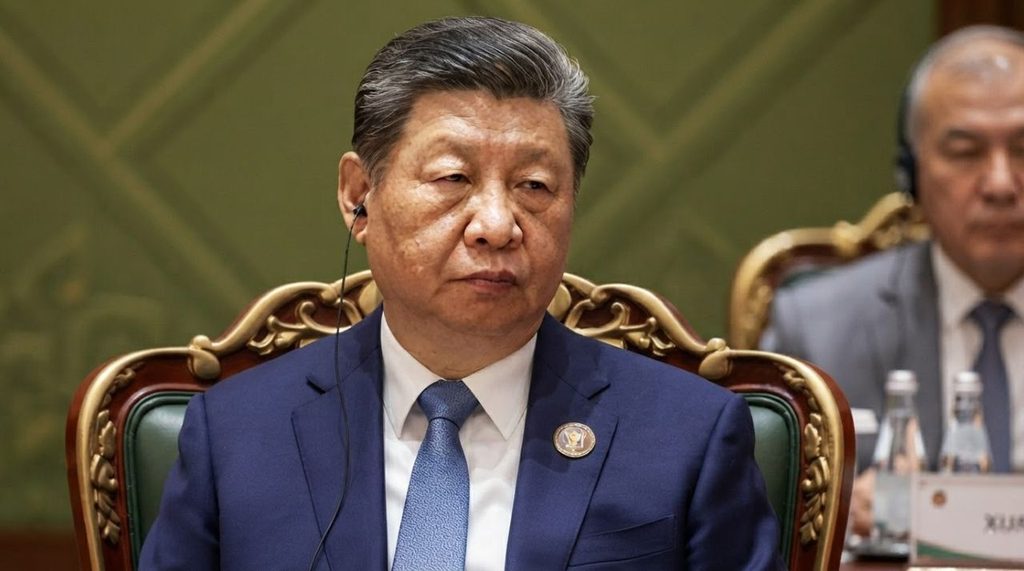
If you spend more than five minutes on geopolitical social media, you’ve almost certainly seen it by now. The whispers start as fringe chatter, morph into breathless viral threads, and end up echoed across algorithmic echo chambers: Xi Jinping has suffered a massive stroke. Or maybe he had a cardiac arrest. Or perhaps the Chinese military has finally stepped in, quietly staging a bloodless coup behind the red-lacquered walls of Zhongnanhai.
The latest iteration of this recurring melodrama is as cinematic as it gets. According to the current wave of online claims, China’s Paramount Leader fell catastrophically ill almost immediately after touching down from an official visit to India. The details are delivered with the usual dramatic flourishes: there were supposedly no welcoming ceremonies at the tarmac, no screeching sirens, no cleared motorcade routes through Beijing, and—most tantalising of all—an emergency evacuation via military helicopter directly to the secretive 301 Hospital. Some posts go a step further, hinting darkly that the People’s Liberation Army has subtly stripped Xi’s personal details and taken over control of his security.
It sounds like a blockbuster political thriller. There’s just one glaring, unavoidable problem: there isn't a single shred of credible evidence to back any of it up.
The Anatomy of an Echo Chamber
Let’s be brutally honest about how these stories work. As analyst Tony Fiddis recently pointed out over at China News Update, this is not a novel phenomenon. It is a well-oiled online machine with a predictable lifecycle.
Not a single reputable news organisation has touched the story. No established foreign correspondent on the ground has found a trace of corroborating fact. Seasoned diplomatic contacts in Beijing, who spend their lives monitoring the subtle tremors of party hierarchy, have come back with completely empty hands.
Yet the story spreads like wildfire anyway. Why? Because the internet has spent the better part of a decade producing near-identical variations of the exact same script:
“Xi is gravely ill.”
“Xi has been placed under house arrest.”
“Xi has lost the support of the generals.”
The trajectory is always identical. A speculative account on X (formerly Twitter) or an anti-CCP dissident forum drops an unverified, dramatic titbit. It gets seized upon by commentators and influencers desperate for an imminent collapse narrative – people eager to believe that the world’s second-largest superpower is about to implode overnight. It gathers millions of impressions, fuels a flurry of breathless YouTube thumbnails, and then quietly evaporates the moment Xi strolls out on state television to inspect a lithium plant or greet an incoming head of state.
Reality fails to cooperate, but the grift simply moves on to the next rumour cycle.
The Opacity Trap: Secrecy Is Not Evidence
None of this means senior Chinese leaders possess biological immortality, clean bills of health, or immunity from the cutthroat factionalism of high-level autocracy. Far from it.
China’s political system is a notorious black box. The health, medical histories, and day-to-day conditions of top leaders in the Chinese Communist Party are treated as classified state secrets. The public is never told when a Politburo Standing Committee member catches the flu, let alone when they require surgery.
Because official transparency is practically non-existent, observers are forced into an extreme form of Kremlinology:
Forensic schedule reading: If Xi misses an anticipated regional economic symposium or goes unseen for four consecutive days, analysts immediately start charting heartbeat monitors.
Protocol micro-analysis: A missing official at a banquet, an unexpected change in motorcade logistics, or an unusual camera angle during CCTV’s Xinwen Lianbo evening broadcast triggers an entire week of feverish conjecture.
Information vacuum filling: In the absence of confirmed data, observers invariably fill the void with the most sensational explanation their imaginations can invent.
The fundamental flaw in this reasoning is confusing opacity with catastrophe. Secrecy is structural to the Chinese state; it is standard operating procedure, not proof of an active crisis. An absence of official information does not constitute evidence of a helicopter airlift to Beijing’s 301 Military Hospital.
The Reality Check: Geopolitics Doesn’t Stop for Rumours
If you want to evaluate whether a superpower’s head of state is genuinely incapacitated, don't look at anonymous social media posts. Look at the diplomatic machinery.
Major summitry requires weeks of gruelling, high-stakes bureaucratic logistics. Advance teams have to coordinate travel itineraries, draft joint memorandums, lock down security protocols, and establish red-line negotiation parameters.
Right now, that machinery is operating at full throttle. Xi Jinping has been preparing for a major, high-stakes meeting in Washington with US President Donald Trump. At the exact same time, Vice Premier He Lifeng is slated to conduct crucial, summit-level economic and trade negotiations in the United States with Treasury Secretary Scott Bessent and US Trade Representative Jamieson Greer.
Think about the sheer practical absurdity here: if Xi were lying in a critical care ward under military supervision, does anyone seriously believe that Beijing’s foreign policy apparatus would be smoothly proceeding with bilateral preparations for an in-person presidential summit?
The continuation of these delicate, high-level diplomatic arrangements is virtually impossible to square with the narrative of a leader clinging to life after a secret helicopter evacuation.
The Bottom Line
Autocracies naturally breed rumours because they throttle verified information at the source. Beijing’s pathological obsession with control and silence ensures that outside observers will always lean toward paranoia whenever the spotlight flickers.
The evidentiary standard matters. Making sense of Chinese politics is difficult enough when working with verified macroeconomic data, military white papers, and concrete diplomatic communiqués. It becomes entirely counterproductive when Western commentators treat every anonymous account on X as if it were a rogue intelligence agency with a high-speed Wi-Fi connection.
Until there are verifiable movements on the ground, confirmed cancellations of core state visits, or credible reporting from vetted correspondents, this latest stroke rumour belongs precisely where all the others ended up: in the recycling bin of geopolitical wishful thinking.