By Tony Fiddis: China Analyst.
The Anatomy of a Purge: Why Xi Jinping Is Gutting His Own Military High Command
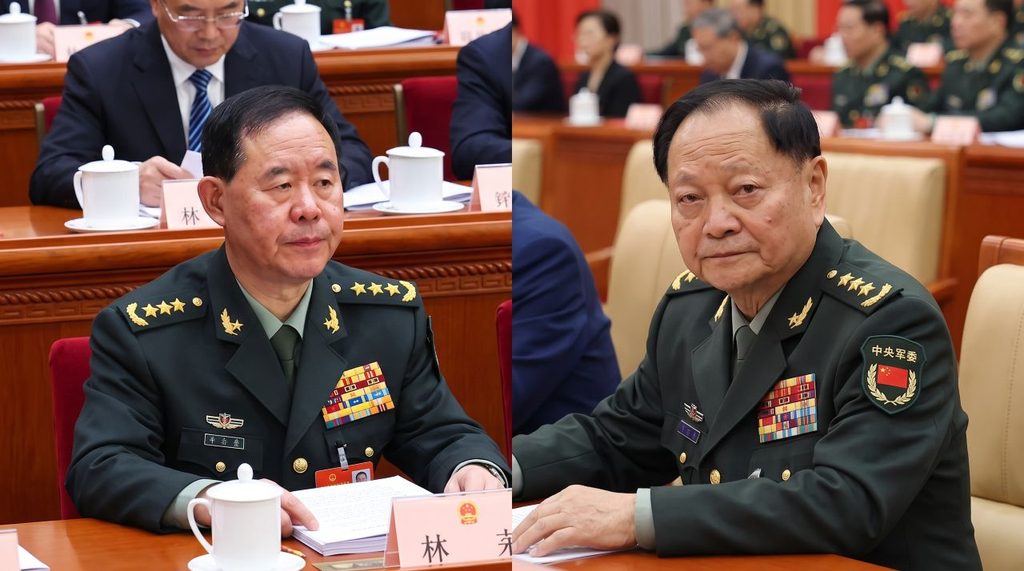
The formal expulsion of General Zhang Youxia and General Liu Zhenli from the Chinese Communist Party and the People’s Liberation Army is not routine political churn. It is a systemic shockwave running straight through the spine of the Chinese defence apparatus.
Zhang was not some faceless bureaucrat shuffling through regional commands; he was the first-ranking vice-chairman of the Central Military Commission (CMC), the supreme command body headed by Xi Jinping. In pure military rank, Zhang was the highest-uniformed officer in China. Liu Zhenli held the reins of the CMC’s Joint Staff Department—the very nerve centre charged with joint warfighting, strategic planning, and combat readiness.
To see both discarded simultaneously marks an extraordinary, destabilising milestone in modern Chinese governance.
The Charge Sheet: When Graft Masks a Breakdown in Trust
Official communiqués released by state media carry the familiar cadence of Chinese anti-corruption sweeps, yet their subtext is lethal. Zhang and Liu stand accused of taking "exceptionally large" bribes, peddling promotions, failing to oversee family members, and engaging in "clique" activities. Their files have been formally directed toward military prosecutors.
Official Allegations vs. Structural Realities
├── Stated Economic Offences:
│   ├── Abuse of procurement channels
│   ├── Selling command promotions
│   └── Siphoning departmental budgets
└── Underlying Political Offenses:
    ├── Creation of factional patronage networks
    ├── Erosion of absolute loyalty to the General Secretary
    └── Breakdown of personal trust within Xi's inner circle
In high-stakes authoritarian regimes, corruption is rarely the actual trigger for removal. Graft is ubiquitous across large procurement bureaucracies. When the charges explicitly cite factionalism, disloyalty, and dishonest conduct, the primary issue ceases to be financial impropriety. The issue is control.
Xi’s security apparatus is signalling that the fundamental covenant holding the upper echelon together—unquestioning personal fealty—has fractured.
The Illusion of Proximity: Why Zhang Youxia’s Fall Matters
To understand the tectonic nature of Zhang’s fall, one has to understand his lineage.
Zhang was considered untouchable. He was a genuine "princeling", bound to Xi Jinping through deep family roots; their fathers had served side-by-side during the Chinese Civil War. More crucially, Zhang was one of the vanishingly few active commanders with actual battlefield experience, having served during the Sino-Vietnamese border conflicts of the late 1970s.
CMC Seven-Member Command Architecture (2022 Mandate)
┌─────────────────────────────────────────────────────────┐
│              Xi Jinping (CMC Chairman)                  │
└──────────────────────────┬──────────────────────────────┘
                           │
      ┌────────────────────┴────────────────────┐
      ▼                                         ▼
[Purged / Expelled]                       [Remaining Active]
• Zhang Youxia (First Vice-Chair)         • General He Weidong (Vice-Chair)
• Liu Zhenli (Joint Staff Chief)          • Admiral Miao Hua (Political Work)
• Li Shangfu (Ex-Defense Minister)
The purge tears down the long-standing assumption that personal ties or revolutionary pedigree offer immunity. Five out of the seven initial leaders who formed the 2022 Central Military Commission have now been targeted, sidelined, or purged outright.
If proximity to the paramount leader cannot insulate the military’s top general, it cannot insulate anyone.
Systemic Paralysis: A Cleaned Military vs. an Effective One
The scale of Beijing's internal clean-up is staggering. Independent tracking by defence think tanks, including the Center for Strategic and International Studies (CSIS), documents dozens of senior PLA generals and flag officers vanishing from public duty or falling under investigation since 2022.
The consequences for disgraced leaders are brutal. Earlier this year, two former defence ministers—Wei Fenghe and Li Shangfu—were handed suspended death sentences with two-year reprieves for severe corruption, penalties that invariably freeze into life imprisonment.
| Official | Former Post | Primary Official Charges | Legal Outcome |
| Wei Fenghe | Minister of National Defence | Bribery, systemic graft, disciplinary breach | Death with 2-year reprieve (May 2026) |
| Li Shangfu | Minister of National Defence | Bribe-taking, unauthorised procurement deals | Death with 2-year reprieve (May 2026) |
| Zhang Youxia | CMC First Vice-Chairman | Factionalism, disloyalty, massive graft | Expelled; referred to military prosecution |
| Liu Zhenli | Chief of Joint Staff Department | Clique-building, dereliction, illicit enrichment | Expelled; referred to military prosecution |
Xi’s apologists claim these measures are essential triage. Their logic is coherent on paper: a fighting force poisoned by bribery, bought commissions, and doctored supply chains cannot withstand modern, high-intensity warfare. Buying stars and stripes does not produce operational competence.
Yet the operational trade-off is severe. When an authoritarian regime subjects its military leadership to continuous internal purges, it risks engineering institutional paralysis:
Incentivised Passivity: Operational commanders quickly learn that personal initiative is dangerous. Rigid ideological obedience and self-preservation supplant operational boldness.
Procurement Freezes: Procurement officials, terrified of falling foul of anti-graft inspectors auditing legacy programmes, delay critical technical sign-offs and programme budgets.
Eroded Warfighting Experience: The removal of figures like Zhang and Liu strips the high command of its few leaders who possess actual combat experience, replacing seasoned strategic hands with political conformists.
An armed force can be audited, disciplined, and investigated directly into structural gridlock just as easily as it can be honed into a modern fighting machine.
Looking Ahead: The 2027 Horizon
These expulsions carry deep political resonance as Beijing marches toward the 21st National Congress of the Chinese Communist Party in late 2027, where Xi Jinping is broadly slated to claim a historic fourth term.
There are no credible indicators that an organised military revolt or systemic coup was brewing. What the purges demonstrate instead is a leader who remains profoundly, relentlessly suspicious of the very power structures he commands.
By eliminating his most seasoned military confidants, Xi has consolidated undisputed personal authority over the barrel of the gun. But absolute control carries a steep, compounding cost. China's military modernisation drive now rests entirely upon the instincts, blind spots, and calculations of one man—governing a command hierarchy too frightened to tell him what he does not want to hear.